
Medium Interests
What are your favorite materials and how much do you know about them? News and views from the DustyNewt Workshop 05/13/2026

Today’s “17 Step Commute” Dashboard…
Temp: Currently 87 degrees. High of 90 today 😎
Humidity: 4 on the “Soup” scale. (1=light broth, 5=thick chowder).
Today’s Playlist: Deep Cut 70s shuffle.
Conditions: Maybe rain, maybe not. 😎
Estimated Travel Time: 18 seconds
Food: Apple and ham sandwich for blunch. Chicken Perloo tonight.
Coffee Level: 1/2 Tank
Material Interests
Understanding your medium is crucial in producing your finest work. Whether you work with woods, wax, metals, stones, clay, fabrics or man-made materials, it is in your best interest to learn how your raw materials come about, where they originate and why they have certain properties that determine their best use.
My Favorite Medium
While I am fascinated by a number of different materials, wood has been my first love. Its beauty, texture and infinite possibilities have intrigued me since… forever. Very probably from the origin of man, it has been part of human existence. Why not mine?
I have been playing and/or working with woods as far back as I can remember, so I naturally learned its strengths and weaknesses. I had wooden toys (Skaneateles Train set and Lincoln Logs) which taught me something about stress and balance, and breaking points.
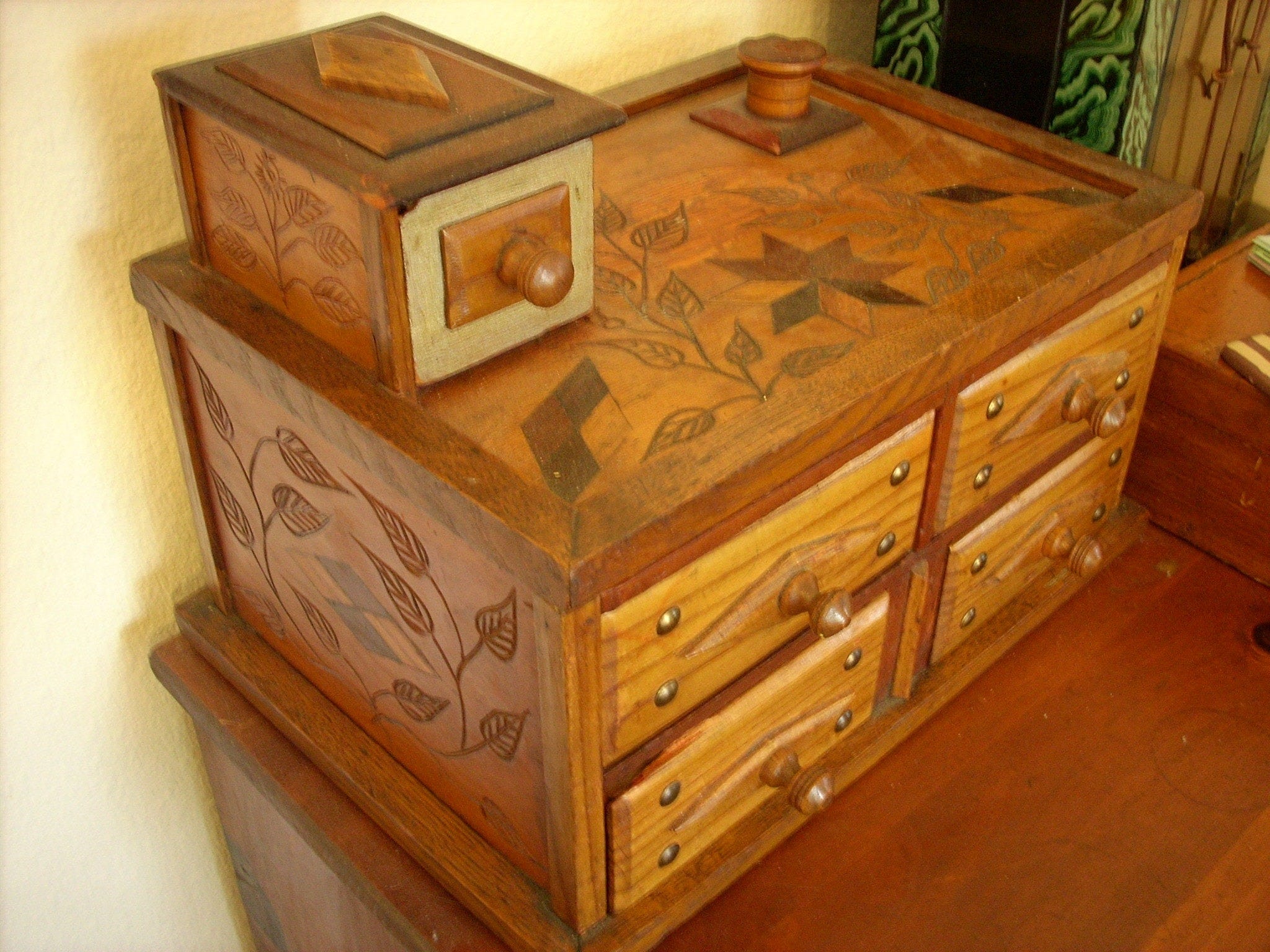
A treasure box I was reminded of in 2008 when visiting with my 89 year old grandma. She told me of my three-year-old self with a favorite place to park my Matchbox cars and plastic army men. Her tramp art jewelry box (circa 1920?). When she had me pull it off the top closet shelf, I immediately pulled out a drawer and held it to my nose. The Spanish cedar aroma (a hobo’s favorite medium was cigar boxes) flashed memories and images from my toddler brain to my forty-five year-old self. I love that box and it now sits on my dresser for a quick sniff when this sixty-three year-old needs it.
At the age of eight, I helped gather firewood, learning how to safely use an axe, a pocket knife and saws to manipulate it as needed. I remember finding a hatchet in the banks of a ravine when I was nine. These gullies were all over central New York when I was a kid. They were a dump (and a gold mine) for unwanted or lost human things going back 300+ years. We regularly found things we would clean up and sell to local antique stores, like discarded bottles and pottery. The hatchet allowed me to start my fort-making period, building hideaways in the woods out back, using dead-fall trees, bushes and childish ingenuity.
Some of my teen years were spent working on and off as a laborer with the Morgan brothers, building garages and demolishing old fish camps around Oneida Lake. I spent uncounted hours salvaging boards, timbers, doors and windows. I would fill a five gallon bucket of rusty and bent nails daily so that the wood could be reused.
When we moved to Florida in 1979, my aunt Judy had a wooden sign business that I inserted myself in, cutting pine patterns on a bandsaw for her children’s character wall plaques and redwood sign blanks, on which she would route the names the customer desired. Redwood was plentiful at the time and available at Scotty’s, a precursor to the Big Box stores of today. I haven’t seen any redwood here in the last 20 years.
It was during slow times working for Judy that I began developing my freehand letter style for wooden bandsaw names. The scraps and off-cuts were small, so the names had to fit and still be readable. With my aunt’s enthusiasm and encouragement, I started making them for customers at campgrounds, malls and fairs when I worked for her… and a couple cold Florida Christmases on the sidewalk in front of Zayres department store.
The next few decades saw a multitude of side-jobs to pay bills, but wood was still central to my life. Doing mall shows, fairs and theme parks were interspersed with antiquing, cooking, cabinetmaking, lettering signs and vehicles, and factory work. Building woodstuffs from scratch or refinishing furniture was always an activity in my home workshop.
For the last thirteen years, I have relied solely on online sales to get my work out (mostly through Etsy) and do it full-time.
Where does it come from?
What are your favorite materials and how much do you know about them?
While a tree is growing, its history is defined by each year’s climate. Each annual ring reveals what kind of year it had. The “summer” wood is thick and softer in years with plenty of water. Hard and thin in drier years or climate conditions.
Stresses during its growth determine its character. Soil conditions, with mineral contents and ph vagaries, determine a tree’s health. Hillsides present gravity challenges for a tree to keep its balance, with grain on the uphill side being more compressed. This is a source of “reactionary” lumber. Be careful as you work it, as it will change on you once micro-stesses are relieved.
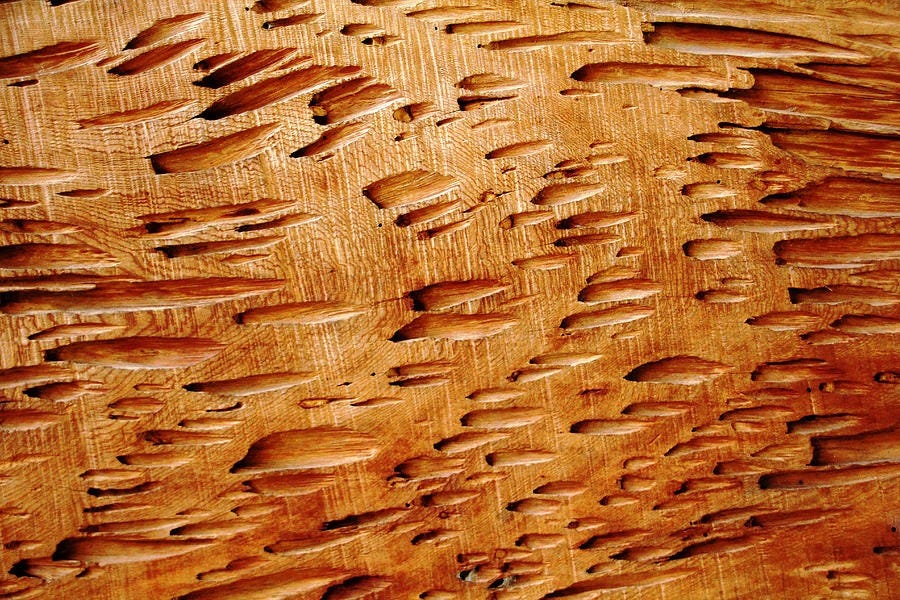
Fungi can feed a tree and cause dramatic figure changes within its grain, like Pecky Cypress (see photo). They transmit existential information throughout the forest (see Wiki).
Insect populations are caretakers and pollinators. Trees are home to thousands of beneficial species of animals. A forest in balance can usually resist occasional attacks of invasives. Humans tend to disrupt this balance whenever they appear, and that is when total blights occur.
It must be said, though… When bringing lumber into your workshop, make sure there is no active insect activity. They will not only infest your existing wood supply, but indeed, eat your shop down. Proper kiln drying kills any insect life and eggs. Fumigation is effective if done by professionals, like when they “tent” a house.
My step-dad Ralph and I once bought a 1960s pinball machine together, intending to restore it to its original form. But it had bugs. So we drove it immediately to an exterminator to see what they would charge to put it in their next home fumigation. It was like $20, so we went ahead. The process worked, there was no more live activity, but as we disassembled the machine, too much damage had been done to the plywood, so we cut our losses.
Some of the hardest and most durable hardwoods come from tropical climates around the world. Ipe from Central and South America, and Teak woods from Asia are some of the strongest, most resist decay and insect resistant species. Cocobolo rosewood from Mexico is one of the most beautiful, to me.
Its Next Incarnations
After life as a tree, its wood can literally be enjoyed for thousands of years. Turning it into lumber to be used in countless human devices (shelter, furniture, boxes, tools, etc.).
Even after kiln drying, when wood is technically dead, it continues to change. Milling it to required sizes and shapes must allow for this movement. Thick, final finishes can slow it down, but not eliminate wood’s nature. With humidity and temperature fluctuations, it expands and shrinks to suit its surroundings. It reacts to light and air, darkening or lightening with age, either by fading or by oxidation.
It can continue to be reused. I once dismantled a rosewood piano (Steinway upright, circa 1890) to put in my woodbins. We got it cheap (less than $50) at auction because no one wanted to move it. It contained beautiful rosewood, sitka spruce, ebony and real ivory veneered keys, and some cool hardware that I probably still have around somewhere.
A FREE subscription gets all of my new blog posts.
I publish a blog every Wednesday afternoon (4:00 pm-ish).
Please subscribe to get it sent directly to your email.
If you enjoy what you read and would like to access my archives and “Learning Center”, I will still happily accept “Paid” subscriptions. I appreciate the encouragement.
I currently sell my work on Etsy and now on Amazon Handmade. Beware of spoof sites, using my photos and descriptions. You will be disappointed ordering from them.

DustyNewt World ~ A map of where I have shipped my woodstuffs. See if your town is represented.

If you are enjoying what you see… I like it hot and black. 😉
